
Successful prompt injections cut by more than half
AgentDojo, ETH Zurich’s prompt-injection benchmark: 16.4% to 6.2% on the same model, with 87% of tasks still done under attack.
Perfect score on PrecisionMemBench
All 77 cases, including all 43 where the memory has to return only the current fact.
Where it covers you
Public benchmarks
Prompt injection on AgentDojo
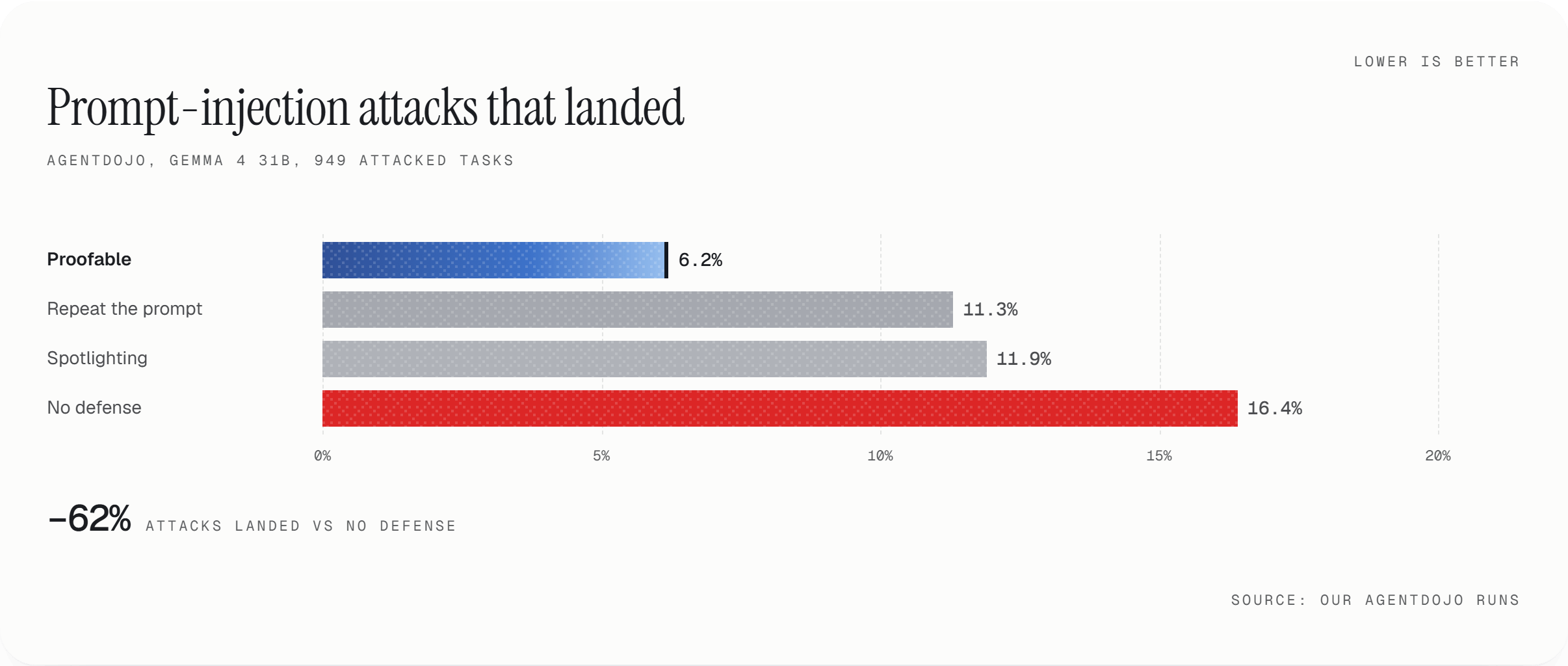
For scale, these are AgentDojo’s published results on other models. With no defense, attacks landed 27.2% of the time on gpt-4o-mini and 47.7% on gpt-4o; the strongest published defense (tool filtering) brought gpt-4o to 6.8% while task completion under attack fell to 56.3%. Our run used gemma-4-31b-it, a model attacks land on, so the rows are the same benchmark and metrics on a different model, not a ranking. The attacks that still land use the very tool the task needs, such as a send or a transfer; a permission cannot tell that call from the legitimate one, which is what spend caps and approvals are for. Per suite and per decision: evidence folder (every one of the 6,934 engine decisions and each task’s signed permission).
Memory that returns only the current fact
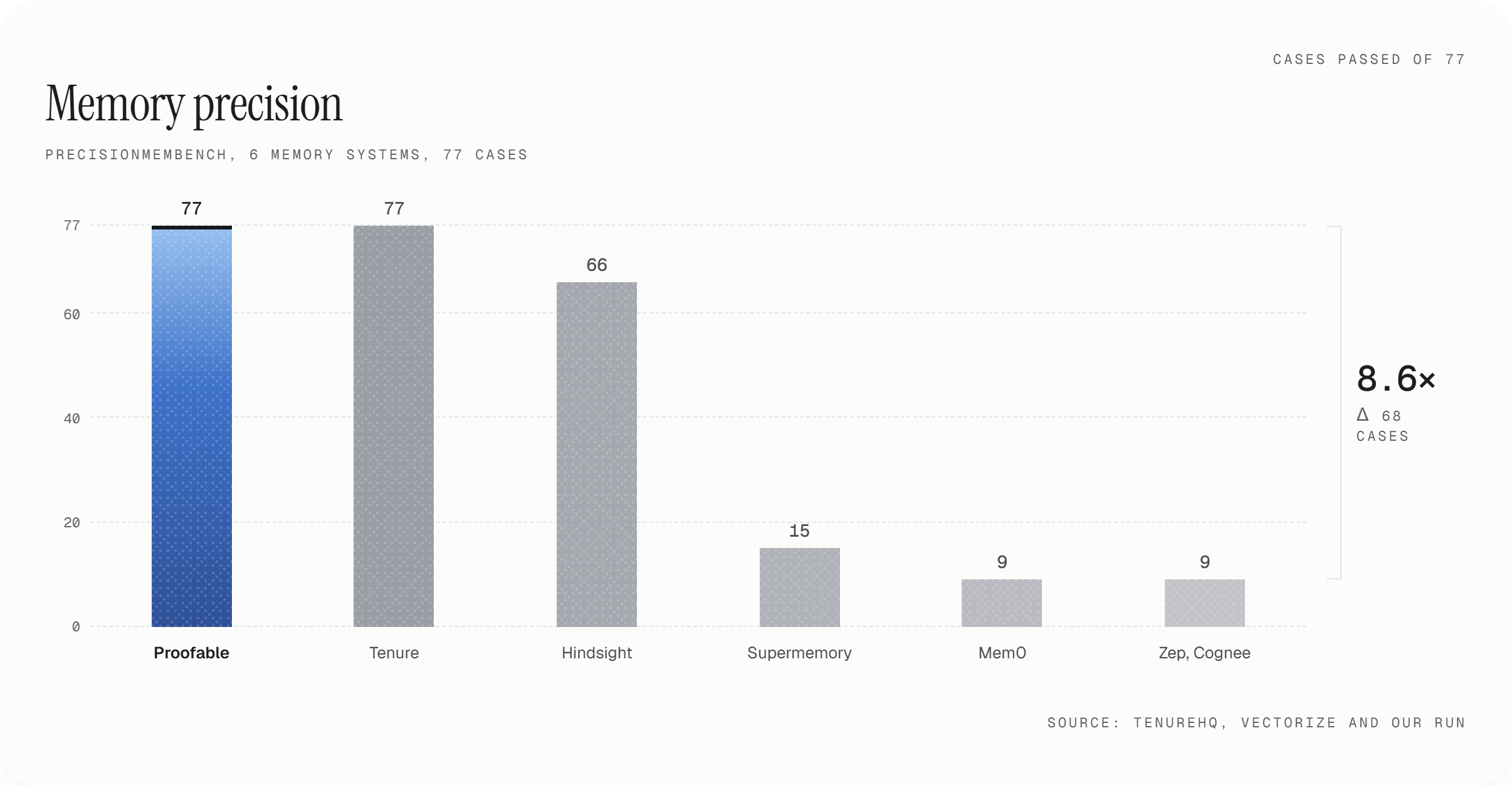
Proofable and Hindsight ran on the same toolkit, so those two rows compare directly. The other rows are the benchmark author’s own results with its own code, and Tenure is the author’s own product. High recall with low precision means the right fact came back buried among unrelated ones.
See where your agent needs Proofable. Paste its repo. Get every action it can take without your permission, with file and line, and the one command that fixes it. Audit your agent free.
Our own tests
Each one links its raw results. Rerun it on your own account or machine.Governance coverage
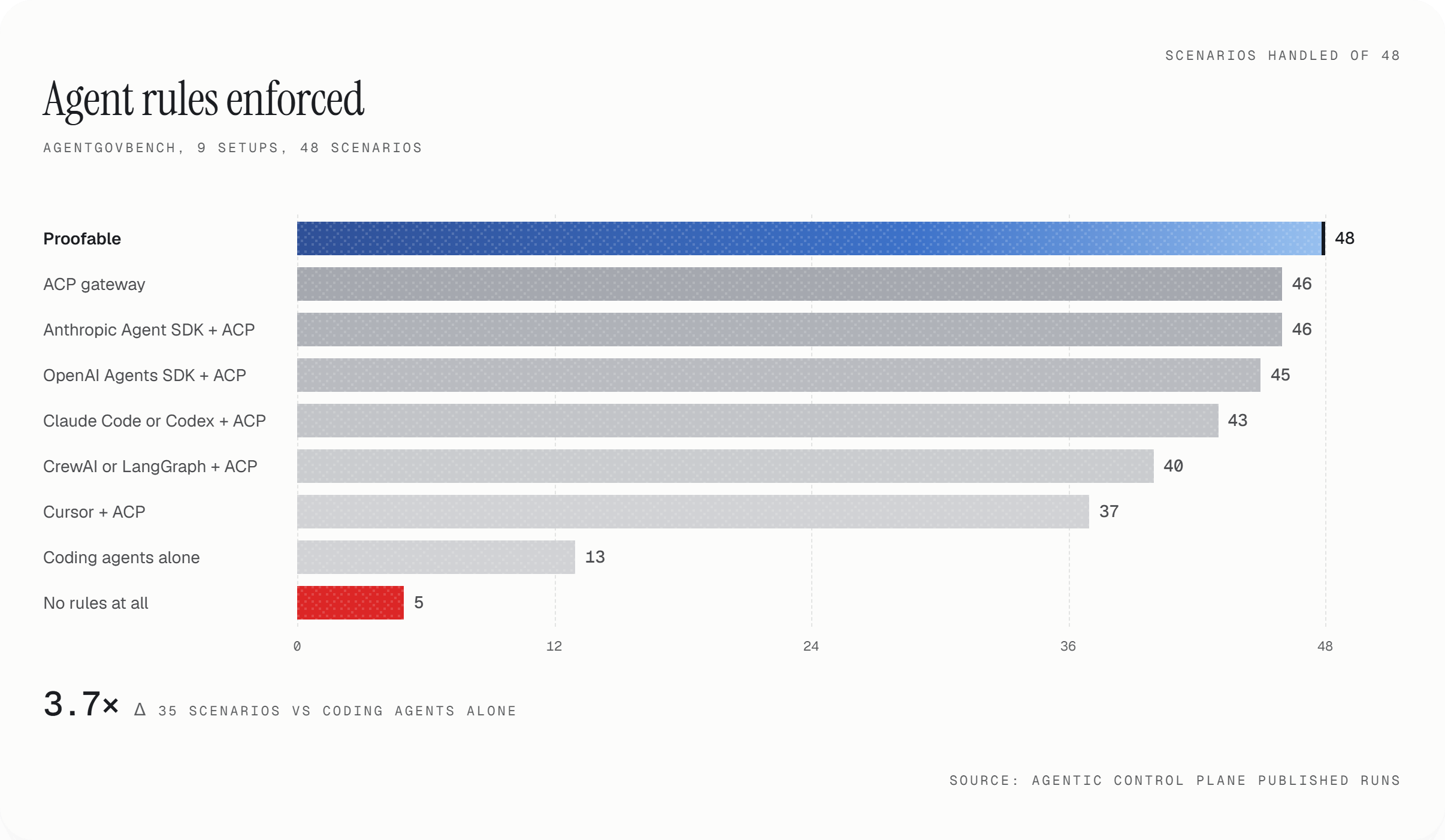
Our row is the policy module the live service runs, pinned by hash, on the maintainers’ current library (
479c5f0). The ACP and agent-tool rows are the maintainers’ published runs, the agent-tool rows on the earlier library (e0ce93a). The agent-tool rows are April runs that predate the maintainers’ scorer changes, and the maintainers flag them for a re-measure, so treat them as indicative.
Why coding agents on their own handle 13, the best gateway handles 46, and Proofable handles 48:
- Coding agents on their own (13): Claude Code, Codex CLI and Cursor only have local tool-permission prompts (
allow/denybash or file access). They have no owner-bound agent identity, no cross-agent delegation, no spend caps, no external policy engine and no signed audit trail. - A stateless API/MCP gateway (46): a proxy in front of tool calls enforces rate limits, role-based access, tool allowlists and server logs.
- The two checks a stateless gateway cannot pass (48): a proxy only sees the request in flight. It cannot verify (1) an owner-signed, revocable delegation binding the person to that specific agent, task scope, spend cap and expiry, such as holding a sub-agent to a narrower scope than its parent, or (2) a signed execution receipt (
qHash) binding input, policy state and output, so the next agent or an outside reviewer can verify what ran offline without trusting the gateway’s database.
Agents only do what you allowed
8 of 8 permission tests pass on the live service. All 15 records. Every action outside the agent’s permission is stopped before it runs, and every action it is allowed to take runs. Each row opens its signed record.
Reviewers in the AgenTrust integrations project verified the records offline on their own machines. Every checksum matched and every signature verified. In the AAIF Observability & Traceability working group, a reviewer checked that the verifier binds each test to its own records and rejects all eight altered copies. Rerun all eight on your own account with Run the chain.
A hijacked agent cannot send your data out
When an agent was taken over, 0 of 6 attempts to send private data out got past a scoped permission. On an all-purpose key, 6 of 6 got out. Five of the six were refused by the permission before they ran and one was never attempted. The scoped agent finished every task and never used a tool outside it (0 of 42 runs); under the all-purpose key, 7 of 42 runs did, with a signed record for each run. Run the test on your own agent.Records nobody can fake
150 of 150 forged records caught. Each of 15 real records was changed ten ways, such as editing the content, swapping the owner or flipping one bit of the signature. Every changed copy failed offline signature verification and every real record passed. A check that only reads the format accepted all 150. Rerun it from the kit in Run it yourself:node tamper-check.mjs changes all 15 records ten ways and verifies every copy offline.
Reuse instead of redo
Redoing a finished agent job took 2.79 s and 2,426 AI tokens. Checking its signed receipt took 3.7 ms and no tokens: 750× faster, which is 1 hour instead of 32 days at a million checks. Time it yourself.Handoffs between agents
When one agent hands a finished result to another (LangGraph, CrewAI, AutoGen), the receiving agent normally either trusts the forwarded text blindly or pays to re-run the upstream work. With Proofable, the producing agent emits a signed receipt (qHash) binding input, policy state and output, and the receiving agent checks it before acting.
- 3.3× cheaper than redoing the work: $0.024 per correct outcome (33,240 tokens, 2 model calls per task) against $0.078 (124,715 tokens, 3 to 5 model calls per task).
- Trusting forwarded text is cheap and wrong: it costs $0.009 on untouched input, but when the text was changed in transit it used the tampered value 3 of 3 times. Checking the receipt caught every change 3 of 3 times and still completed every task, where blind trust caught 0 of 3.
- 29× smaller handoffs: across a 10-hop chain, passing the signed reference carried 9,900 bytes per hop instead of 289,410 bytes of full evidence.
Memory that knows what is current
Most agent memory layers (Mem0, Zep, vector stores) return text chunks with no active or revoked status and no signer, so the agent keeps reading full bodies to work out which rule is current. Proofable stores typed, revocable, owner-signed records (rules, instruction, receipts), so the agent asks for active state by type and reads about 1 KB of verified metadata before opening a body.
On a 3,621-record production vault, the questions both methods answered correctly took 43,169 tokens in 66 seconds (6 model calls) by typed lookup against 479,623 tokens in 178 seconds (10 model calls) searching record bodies by keyword: 11.1× fewer tokens, 2.7× faster, and 11.8× to 12.7× lower model cost across Claude Sonnet 5.5, Gemini 3.1 Pro and GPT-6 Astra.
Research with a cost ceiling
Live pages change between requests: two fetches of the same page 221 seconds apart returned 96,713 characters, then 1,129, handing two agents different evidence with no way to prove what the page said when the decision was made. On public questions about standards, agent protocols and regulation, reading signed Proofable records halved the cost per correct answer ($0.020 vs $0.039), held the worst case to 16,301 tokens where open-web search spiked to 50,554 tokens and 104 seconds (3.1× lower), and cited a checkable source on every answer (6 of 6, against 5 of 6 on the open web).Identity checks paid for once
A person or business completes an interactive check once, and downstream apps and agents verify the portable proof instead of paying the vendor to run the flow again. Priced from published vendor list prices and Proofable’s $0.0025 per check:Run it yourself
Time a reuse on your own machine, with no account and no API key:Run it on every pull request
Add one workflow file and the eight permission tests run in your CI, on your account, with every record verified offline and kept as a build artifact:trustharness.report/v1 report with each case’s outcome and whether each record verified offline, and fails the job when the offline check fails. Action and report schema.
Details for reviewers
Verify every record offline
Verify every record offline
The latest run of the permission tests produced 15 signed records. Check all of them on your machine, with no account:Then, from
../reproduce/, node aad.mjs verify ../2026-11-02-suite recomputes every checksum, the trace digest and all 15 envelopes offline, counts the trace rows and computes the coverage from them, and node aad.mjs report ../2026-11-02-suite prints the typed cost and the grading scope.How each result was measured
How each result was measured
- Governance: AgentGovBench at the maintainers’ current library (commit
479c5f0), run through the library’s own runner against the policy code the live service runs, matched to it by hash, beside a gate that allows everything and a no-governance arm. The agent-tool rows are the maintainers’ published runs on the earlier library (commite0ce93a). - Permissions: each test on the live service with a dedicated agent under its own fixed permission, and the full suite again on a production release. A permission revoked while its job is running stops that job with a typed reason, and the next dispatch under it is refused.
- Takeover: 84 live runs across five published attack templates and two models, with a signed record for each run.
- Reuse: the median of ten runs on one finished job on the live service.
- Handoffs: three public downstream tasks, one run per option, code-graded, with a separate producer and consumer agent on the same model. Dollar figures price the measured tokens at the Claude Sonnet 5.5 list rate ($2 input, $10 output per million). The 10-hop payload sizes are over the 15 published records.
- Memory: the same agent and model on both options, one run each. It compares typed lookup of active state (by record scope and status before a body is fetched) with full-text keyword search over record bodies; it is not an embedding-similarity benchmark.
- Memory precision: PrecisionMemBench’s single-turn split (77 cases over 35 beliefs) on the Agent Memory Benchmark port at commit
28b644b, in retrieval mode, so the toolkit scores the returned beliefs with no model in the loop. Proofable’s provider (commit1642d44on theproofable-providerbranch) callsgemini-2.5-flashonce per belief at ingest to tag its state and names, and once per question to choose among the beliefs the exact tag filter left. Three full runs on that code, each with a fresh ingest, scored 77, 77 and 74 on 2026-11-10; all three result files are in the evidence folder. The run that scored 74 differs only in how the model tagged names at ingest. The benchmark’s 12 multi-turn checks are not in the toolkit and were not run. The benchmark author’s table was retrieved 2026-11-10. - Research: six public questions, one run per option, same agent and model. Both options answered 6 of 6 correctly, so it measures cost ceiling, tail spread (1.3× against 6.1×) and provenance rather than accuracy.
- Identity: a pricing model from published list prices, not a live run.
public/evidence/benchmarks, pinned by commit and checksum.Third-party benchmarks are their authors’ work: AgentGovBench (Agentic Control Plane), AgentDojo (ETH Zurich SPY Lab, MIT licence), PrecisionMemBench (TenureHQ) and the Agent Memory Benchmark harness (Vectorize). None of them endorses these results; where a row is ours it says so.Standards each result maps to
Standards each result maps to
Each result maps to the published control it gives evidence for. None of these mappings is a certification or a compliance opinion.
The frameworks: OWASP Top 10 for Agentic Applications 2026, the EU AI Act, the NIST AI RMF, the NIST NCCoE agent identity and authorization project and CAIP-380. AARM frames the runtime-authorization controls, and the evidence also sits in the AAIF Identity & Trust working-group comparison.